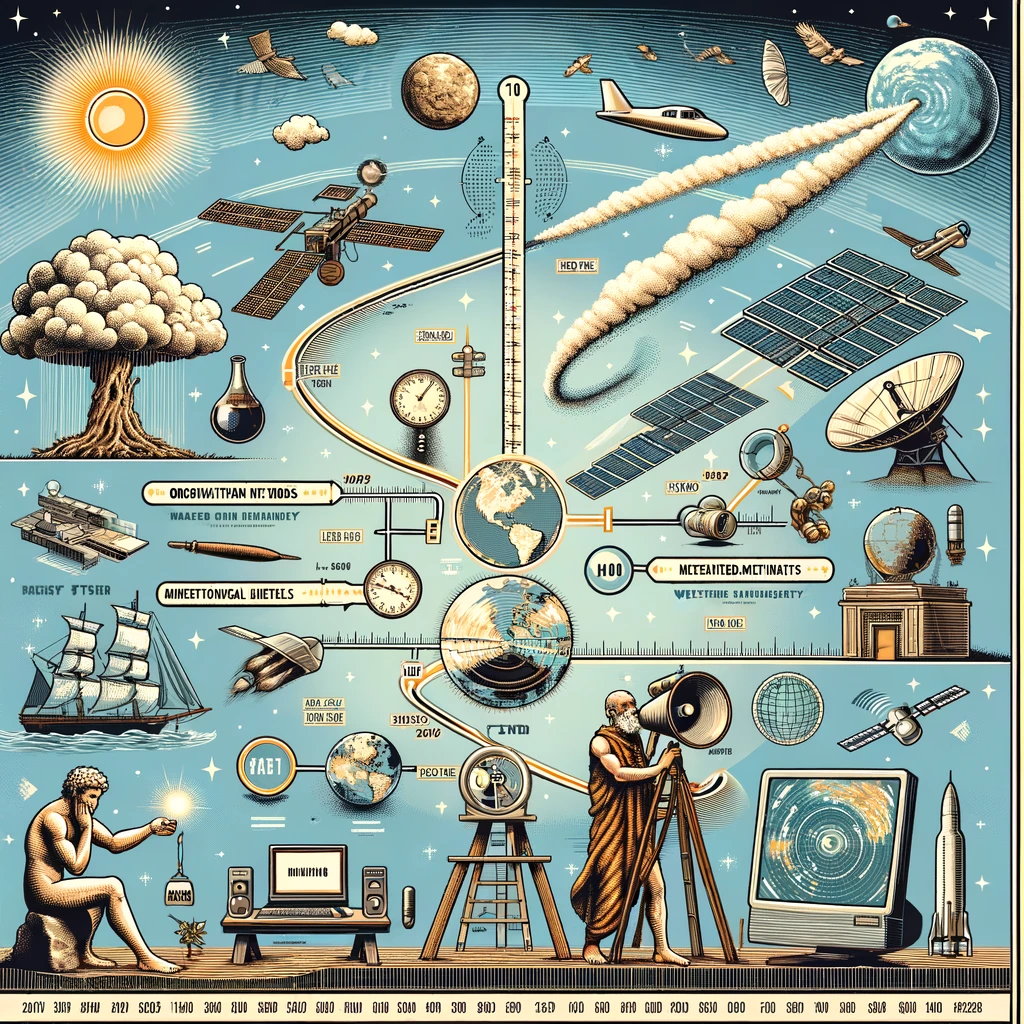
Unveiling the Clouds of Time: The Evolution of Weather Forecasting
 0
 0
Weather forecasting is a dance with the elements, a historical journey that mirrors humanity’s quest for understanding and control over the natural world. This narrative traces the evolution of weather prediction from its ancient roots to the sophisticated science it has become today.
The art of forecasting weather has ancient origins, tied closely to the survival and development of civilizations. Early humans relied on observational techniques, noting changes in wind, cloud patterns, and animal behavior to predict short-term weather changes. These rudimentary methods were crucial for agriculture, navigation, and planning.
As civilizations advanced, so did the methods of weather prediction. The Babylonians, around 650 BC, were among the first to apply a rudimentary form of meteorology, using cloud patterns and astrology to forecast weather. This blend of observation and mysticism underscored early attempts at weather prediction, highlighting humanity’s desire to decipher the skies.
The scientific revolution of the 17th century marked a pivotal shift in weather forecasting, transitioning from a reliance on superstition to empirical observation and measurement. The invention of meteorological instruments, such as the thermometer by Galileo and the barometer by Evangelista Torricelli, provided the tools necessary for more accurate and systematic weather observations. These innovations paved the way for the development of synoptic meteorology in the 19th century, which relies on simultaneous observations of the weather from multiple locations to understand large-scale weather patterns.
The 20th century heralded the advent of modern meteorology, fueled by technological advances and a deeper understanding of atmospheric physics. The development of radar during World War II and the launch of the first weather satellite, TIROS-1, in 1960, revolutionized weather forecasting by providing real-time, comprehensive data on atmospheric conditions. These technologies enabled meteorologists to predict weather with greater accuracy and over longer periods.
Today, weather forecasting is a sophisticated science that employs advanced computer models, satellites, and radar systems to predict weather patterns days and even weeks in advance. These models simulate the atmosphere’s dynamics, taking into account various factors such as temperature, humidity, and wind patterns to generate forecasts. The integration of artificial intelligence and machine learning has further enhanced the precision of these predictions, enabling meteorologists to analyze vast datasets more efficiently and identify trends that would be impossible for humans to discern alone.
Despite these advances, weather forecasting remains an inherently uncertain science due to the complex and chaotic nature of the atmosphere. Forecasters are continually refining their models and techniques to improve accuracy, but the unpredictable nature of weather ensures that some degree of uncertainty will always remain.
The evolution of weather forecasting reflects humanity’s enduring fascination with the natural world and our relentless pursuit of knowledge. From observing the skies with the naked eye to harnessing the power of advanced computing, the journey of weather prediction is a testament to human ingenuity and our desire to understand and anticipate the forces of nature. As we look to the future, the continued advancement of technology and science promises to further unravel the mysteries of the atmosphere, bringing us ever closer to the elusive goal of perfect prediction.